No products in the cart.


Need Help?
+8801822361899
Sign In
Registration complete. Please check your email.
Create an account
The user name or email address is not correct.
Reset password
Password reset email has been sent.
The email could not be sent. Possible reason: your host may have disabled the mail function.
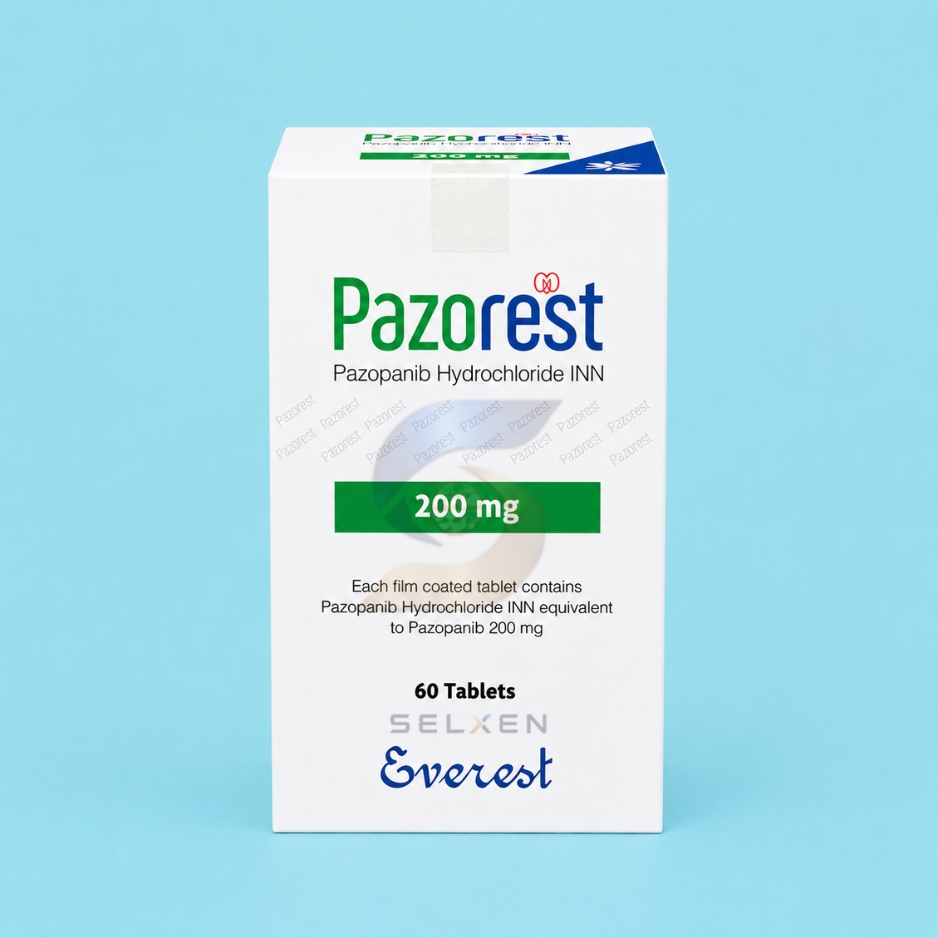
Pazorest 200 mg (Pazopanib)
- Disclaimer : Before purchasing any medicine, always verify whether there is a valid drug license.
How to know the original Everest products?
To verify an Everest product, first scan the QR code printed on the box. The QR code will take you to the official verification page.
After opening the box, check the bottle for its unique verification code. Enter this code on the verification page to confirm the product’s authenticity.
If the verification is successful, the product is legitimate. However, if a verification error appears, do not use or purchase the product. It may be fake or counterfeit. Fake products should be reported or safely disposed of according to local guidance.
Introduction
Pazorest 200 mg contains pazopanib hydrochloride, an oral targeted cancer medicine belonging to the tyrosine kinase inhibitor family. It is manufactured by Everest Pharmaceuticals Ltd. and is listed by the manufacturer as a 200 mg pazopanib product. Pazopanib is used for specific advanced cancers, including advanced renal cell carcinoma and certain advanced soft tissue sarcomas following prior chemotherapy.
One important point is that 200 mg refers to the tablet strength. It does not automatically mean that 200 mg once daily is the standard dose for every patient. For many adults, the labeled starting dose is 800 mg once daily without food. Doctors may use 200 mg tablets when adjusting the total daily dose for tolerability, liver impairment, or other clinical reasons. Because pazopanib can cause serious adverse reactions, treatment should remain under oncology supervision. Liver tests, blood pressure, cardiac risk factors, and other laboratory findings may require monitoring during treatment.
Everest Pharmaceutical Ltd. and Selxen: Understanding the Mechanism and Usage
Pazorest is manufactured by Everest Pharmaceuticals Ltd., which lists Pazorest among its oncology products as pazopanib 200 mg. Selxen is positioned as the global access and knowledge bridge for patients and healthcare professionals seeking information about oncology medicines. Product availability, shipping eligibility, and import requirements can differ between countries. For this reason, users should confirm current availability and applicable requirements before placing an international order.
Selxen: Bridging Global Access and Knowledge
Access to prescription oncology medicines can involve more than simply locating a product online.
A responsible global-access service should help users understand:
- Product identity.
- Manufacturer.
- Strength.
- Pack information.
- Prescription requirements.
- Availability.
- Shipping considerations.
- Product documentation.
- Appropriate medical supervision.
The goal should be reliable access to legitimate medicines rather than encouraging self-medication.
Oncology Information Provider Section: Empowering Informed Choices
Pazorest should be viewed as part of a physician-directed cancer treatment plan. Patients should not start, stop, increase, decrease, or combine pazopanib based only on online information. The appropriate dose depends on the cancer being treated, treatment history, liver function, other medicines, tolerability, and clinical response.
Global Accessibility Through Selxen
Global access to Pazorest 200 mg may depend on destination-country regulations, prescription requirements, and product availability.
Before ordering, confirm:
- The prescription requirement.
- The exact product and strength.
- Manufacturer information.
- Pack quantity.
- Expiry date.
- Shipping eligibility.
- Storage conditions.
- Local import requirements.
What Is Pazorest 200 mg?
Pazorest 200 mg is a prescription tablet containing pazopanib hydrochloride, a multi-targeted tyrosine kinase inhibitor. Pazopanib blocks signaling through several receptor tyrosine kinases involved in angiogenesis and tumor growth. Important targets include VEGFR-1, VEGFR-2, VEGFR-3, PDGFR and FGFR pathways. The medicine is not a general-purpose cancer treatment. Its approved uses depend on the cancer type and applicable regulatory labeling.
Manufactured Excellence By Everest Pharmaceuticals Ltd.
Everest Pharmaceuticals Ltd. identifies Pazorest as Pazopanib 200 mg within its oncology product portfolio. Independent medicine databases also identify Pazorest 200 mg as a pazopanib hydrochloride tablet manufactured by Everest Pharmaceuticals Ltd. Product-specific claims about certifications, bioequivalence, or batch testing should be supported by appropriate documentation rather than assumed from the generic name alone.
Clinical Evidence
Pazopanib has been studied extensively in advanced renal cell carcinoma and soft tissue sarcoma. The PALETTE phase III study evaluated pazopanib in adults with advanced soft tissue sarcoma whose disease had progressed after prior chemotherapy. The trial compared pazopanib 800 mg once daily with placebo. Clinical evidence therefore supports pazopanib’s role in specific oncology settings, but individual treatment decisions must consider disease subtype, previous treatment, overall health, and the oncologist’s assessment.
Side Effects and Safety Protocols
Pazopanib has important safety risks. The FDA prescribing information carries a boxed warning for hepatotoxicity, including severe and potentially fatal liver injury. Liver-function testing is therefore an important part of treatment monitoring.
Other clinically important risks include:
- Hypertension.
- QT prolongation.
- Cardiac dysfunction.
- Hemorrhage.
- Arterial or venous thromboembolic events.
- Proteinuria.
- Gastrointestinal perforation or fistula.
- Impaired wound healing.
- Hypothyroidism.
- Reversible posterior leukoencephalopathy syndrome.
- Interstitial lung disease or pneumonitis.
- Tumor lysis syndrome.
Seek urgent medical attention for severe abdominal pain, significant bleeding, chest pain, severe shortness of breath, neurological changes, fainting, or other serious symptoms.
Clinical Experience of Medical Expert
Pazopanib requires experienced clinical supervision because its risks can involve several organ systems.
A qualified oncologist may assess:
- Cancer type and stage.
- Previous therapies.
- Liver function.
- Blood pressure.
- Cardiac history.
- Current medicines.
- Bleeding risk.
- Planned surgery.
- Pregnancy potential.
- Treatment tolerance.
This page provides educational information and does not replace an individual medical assessment.
Generic Name: Pazopanib Hydrochloride
The active drug is commonly referred to simply as pazopanib.
Brand Name: Pazorest
Strength: 200 mg
The 200 mg designation refers to the strength of each tablet. It should not be interpreted as a universal daily treatment dose.
Dosage Form: Tablet for oral administration.
Drug Class: Multi-targeted tyrosine kinase inhibitor (TKI).
Therapeutic Category: Targeted anticancer therapy / anti-angiogenic kinase inhibitor.
Who manufactures Pazorest?
Everest Pharmaceuticals Ltd.
The manufacturer’s product listing includes Pazorest under its oncology portfolio as pazopanib 200 mg.
How Does Pazopanib Work?
Pazopanib inhibits multiple receptor tyrosine kinases involved in blood-vessel formation and cancer-cell signaling.
Important targets include:
- VEGFR-1.
- VEGFR-2.
- VEGFR-3.
- PDGFR-alpha.
- PDGFR-beta.
- FGFR.
- Other kinase pathways.
By inhibiting these pathways, pazopanib can interfere with signaling involved in angiogenesis and tumor progression.
What Diseases Does It Treat?
Pazopanib is used for:
- Advanced renal cell carcinoma (RCC).
- Advanced soft tissue sarcoma (STS) after prior chemotherapy, in appropriate patients.
The efficacy of pazopanib has not been established for adipocytic soft tissue sarcoma or gastrointestinal stromal tumors in the labeled indication. It should not be promoted as a treatment for other cancers unless a qualified clinician is using it under an appropriate clinical indication.
Benefits of Pazorest
Potential treatment advantages include:
- Oral administration.
- Targeted kinase inhibition.
- Activity against angiogenesis-related signaling.
- Established clinical evidence in selected cancers.
- Availability in a 200 mg tablet strength that can support individualized dose modification.
These are therapeutic characteristics, not guarantees of individual treatment response.
Who Can Take Pazorest?
Pazorest may be appropriate for adults with an approved indication when an oncologist determines that pazopanib is suitable.
Before treatment, the healthcare team should review:
- Diagnosis.
- Previous cancer treatments.
- Liver function.
- Blood pressure.
- Cardiovascular history.
- Current medicines.
- Bleeding history.
- Surgical plans.
- Pregnancy status or reproductive potential.
Who Should Not Use It?
Do not use Pazorest if you have a known serious hypersensitivity to pazopanib or any component of the prescribed product. More broadly, patients with severe clinical risk factors may require alternative treatment or special management. The FDA label lists no formal contraindications for the reference product, while emphasizing major warnings and precautions. Therefore, severe liver disease, major cardiovascular risks, interacting medicines, or other concerns should be assessed by the treating clinician rather than treated as simple self-diagnosed contraindications.
Dosage of Pazorest
The labeled adult starting dose for many approved indications is 200 mg once daily without food. Because Pazorest is supplied as 200 mg tablets, a physician may use multiple tablets to reach a prescribed total daily dose. A 200 mg tablet may also be relevant when the clinician reduces the dose because of toxicity or specific patient factors. For patients with moderate hepatic impairment, the FDA labeling specifies 200 mg once daily. Never select a dose based only on tablet strength.
How to Take Pazorest
Take pazopanib:
- Once daily as prescribed.
- Without food.
- At least 1 hour before or 2 hours after eating.
- At approximately the same time each day.
- With water.
- Whole rather than crushed or chewed.
Food can substantially increase pazopanib exposure. Following the empty-stomach rule is therefore important.
What Happens If You Miss a Dose?
If the next scheduled dose is less than 12 hours away, the missed dose should generally be skipped. Do not take an extra dose to compensate unless your treating clinician specifically instructs you to do so.
Available Strengths
Pazorest is identified by Everest Pharmaceuticals as: Pazopanib 200 mg Other pazopanib brands may be available in different strengths. However, the availability of another brand or strength does not mean it can be substituted without professional guidance.
Available Pack Sizes
Current Bangladesh medicine references list Pazorest 200 mg as a 28-tablet pack. Because pack sizes and international availability can change, confirm the current pack before ordering.
Possible Side Effects of Pazopanib
Commonly reported adverse effects include:
- Diarrhea.
- Hypertension.
- Nausea.
- Vomiting.
- Fatigue.
- Loss of appetite.
- Hair-color changes.
- Increased liver enzymes.
- Weight loss.
- Skin or hand-foot changes.
Clinical databases also report changes in blood counts and electrolyte abnormalities.
Not every patient experiences these effects.
Blood-Related Side Effects
Pazopanib can affect blood-test results.
Possible abnormalities include:
- Leukopenia.
- Neutropenia.
- Thrombocytopenia.
- Lymphocytopenia.
Your oncology team may order periodic blood tests to identify clinically important changes.
Serious Side Effects
Important serious reactions include:
- Severe liver injury.
- Severe hypertension.
- QT prolongation and torsades de pointes.
- Cardiac dysfunction.
- Major bleeding.
- Blood clots.
- Gastrointestinal perforation or fistula.
- Proteinuria.
- Severe wound-healing complications.
- Neurological complications.
The current prescribing information emphasizes liver toxicity and recommends regular liver-function monitoring.
Drug Interactions
Pazopanib is primarily metabolized through CYP3A4 and can interact with medicines that inhibit or induce this pathway.
Important interaction categories include:
- Strong CYP3A4 inhibitors.
- CYP3A4 inducers.
- Certain acid-reducing medicines.
- Some statins.
- Medicines affecting QT interval.
- Selected CYP enzyme substrates.
Grapefruit and grapefruit juice may also affect pazopanib exposure and should be discussed with the healthcare team. Do not start an over-the-counter medicine, supplement, or herbal product without checking with your pharmacist or oncologist.
Foods to Avoid While Taking Pazopanib
The most important food instruction is timing. Take pazopanib on an empty stomach: At least 1 hour before food or 2 hours after food. Grapefruit or grapefruit juice may alter drug metabolism and should generally be avoided unless your healthcare professional confirms otherwise.
Pregnancy and Breastfeeding
Pazopanib can cause fetal harm. Women who can become pregnant should discuss effective contraception with their healthcare provider. Current product information advises contraception during treatment and for at least two weeks after the final dose. Breastfeeding is not recommended during treatment because the presence and effects of pazopanib in human milk are not adequately established and serious adverse effects in breastfed infants are possible.
Monitoring During Treatment
Monitoring may include:
Liver Function
ALT, AST, bilirubin, and other liver tests may be checked before and during treatment.
Blood Pressure
Pazopanib can cause hypertension, so blood-pressure monitoring is important.
Cardiac Monitoring
Patients with relevant risk factors may need ECG and electrolyte monitoring because pazopanib can prolong the QT interval.
Urine Protein
Urinalysis may be used to monitor proteinuria.
Thyroid Function
Thyroid abnormalities can occur during treatment, so thyroid testing may be appropriate.
Blood Counts
Periodic laboratory testing may help identify treatment-related hematologic abnormalities.
Storage Instructions
Store Pazorest according to the product packaging instructions. For pazopanib products, published medicine information commonly recommends storage below 30°C, protected from unsuitable environmental conditions and kept out of children’s reach.
Do not use tablets that are damaged, visibly altered, or stored improperly.
Advantages of Pazorest
Potential practical advantages include:
- Oral tablet administration.
- 200 mg tablet strength.
- Established pazopanib mechanism.
- Use in selected advanced cancers.
- Manufacturer identification.
- Availability within Bangladesh’s oncology medicine market.
Limitations of Pazorest
Pazorest also has important limitations:
- It is not suitable for every cancer.
- It requires prescription and oncology supervision.
- It can cause serious toxicity.
- Drug interactions can be clinically significant.
- Liver and blood-pressure monitoring may be necessary.
- Dose changes should be clinician-directed.
- Treatment response varies between patients.
Genetic Testing Before Starting Treatment
Unlike some targeted medicines that require a specific tumor mutation before use, pazopanib’s labeled use for renal cell carcinoma and soft tissue sarcoma is not based on a single mandatory companion genetic test. However, modern oncology treatment decisions may involve pathology, imaging, molecular testing, or other biomarkers depending on the cancer type. Your oncologist should determine whether genetic or molecular testing is appropriate for your particular diagnosis.
Clinical Studies Supporting Pazopanib
The VEG105192 clinical program helped establish pazopanib activity in advanced renal cell carcinoma. The PALETTE trial was a randomized phase III study evaluating pazopanib in advanced soft tissue sarcoma after prior chemotherapy. PALETTE provides important evidence for pazopanib in appropriate soft tissue sarcoma patients. However, trial results describe groups of patients and cannot predict the outcome for an individual person.
Manufacturer Information
Pazorest is manufactured by Everest Pharmaceuticals Ltd. Everest’s official product listing includes Pazorest under its oncology portfolio and identifies the active ingredient as pazopanib 200 mg. Independent Bangladesh medicine references likewise identify Pazorest 200 mg as pazopanib hydrochloride manufactured by Everest Pharmaceuticals Ltd.
Why Buy From Us?
A responsible oncology-medicine supplier should focus on more than price.
Customers should receive:
- Clear product identification.
- Manufacturer transparency.
- Prescription verification.
- Secure ordering.
- Appropriate packaging information.
- Availability confirmation.
- Support for product questions.
- Confidential handling of prescription information.
Avoid purchasing from sources that cannot clearly identify the product, manufacturer, expiry information, or prescription requirements.
Shipping & Delivery
International delivery depends on destination, customs procedures, prescription requirements, product availability, and courier restrictions.
Before payment, confirm:
- Destination eligibility.
- Current stock.
- Pack size.
- Shipping method.
- Estimated delivery window.
- Required documentation.
- Import requirements.
Do not promise a fixed delivery time unless the logistics provider has confirmed it.
Authenticity Guarantee
Authenticity should be supported through practical verification rather than marketing language alone.
Before accepting a shipment:
- Check the brand name.
- Check the generic name.
- Confirm the 200 mg strength.
- Check the manufacturer.
- Inspect the packaging.
- Check batch and expiry information.
- Confirm that seals are intact.
- Compare the product with approved or manufacturer-provided information.
- Contact the supplier if any detail appears inconsistent.
If a product appears tampered with or suspicious, do not use it until a qualified professional or authorized source has assessed it.
Prescription Requirements
Pazorest is a prescription oncology medicine. Patients should have a valid prescription and should use pazopanib under the supervision of an appropriately qualified healthcare professional. The prescribing clinician should determine the indication, dose, treatment duration, monitoring schedule, and dose modifications.
Conclusion
Pazorest 200 mg (Pazopanib) is an oral targeted cancer medicine containing pazopanib hydrochloride and manufactured by Everest Pharmaceuticals Ltd. It is used in specific advanced cancer settings, including advanced renal cell carcinoma and selected soft tissue sarcomas after prior chemotherapy. The most important practical point is that 200 mg describes the tablet strength, not necessarily the patient’s complete daily dose. The usual labeled starting dose for many adults is 800 mg once daily without food, while 200 mg tablets may be used for dose adjustment or particular clinical situations.
Because pazopanib can cause serious liver, cardiovascular, bleeding, gastrointestinal, and other complications, treatment should be guided by an oncology professional. For legitimate purchasing, users should confirm product identity, manufacturer, prescription requirements, availability, packaging, and delivery conditions before ordering.
FAQs
What are common Pazorest side effects?
Common effects can include diarrhea, hypertension, nausea, fatigue, appetite loss, hair-color changes, elevated liver enzymes, and other laboratory abnormalities.
Can Pazorest cause liver problems?
Yes. Hepatotoxicity is a major safety concern with pazopanib. Liver-function testing is recommended before and during treatment.
Can I take grapefruit with Pazorest?
Grapefruit and grapefruit juice can affect drug metabolism and may increase pazopanib exposure. Discuss grapefruit consumption with your healthcare professional.
Can I take Pazorest with antacids or acid-reducing medicines?
Some acid-reducing medicines can decrease pazopanib absorption. Ask your pharmacist or oncologist before using PPIs, H2 blockers, or antacids during treatment.
What should I do after missing a dose?
If your next dose is less than 12 hours away, the missed dose should generally be skipped. Do not double the next dose unless your healthcare professional specifically tells you to do so.
Can I use Pazorest during pregnancy?
Pazopanib can cause fetal harm. Anyone who is pregnant, planning pregnancy, or capable of becoming pregnant should discuss the risks and contraception requirements with a healthcare professional.
Be the first to review “Pazorest 200 mg (Pazopanib)” Cancel reply
Related products




Need Help?
Our friendly support team is here to assist you with orders, shipping, returns, product information, and any questions you may have. Contact us anytime, and we’ll be happy to help.
- 89 Motijheel, Dhaka, Bangladesh
Services
Copyright 2026. selxen.com All Rights Reserved
Product was successfully added to your cart!
Reviews
There are no reviews yet.