No products in the cart.


Need Help?
+8801822361899
Sign In
Registration complete. Please check your email.
Create an account
The user name or email address is not correct.
Reset password
Password reset email has been sent.
The email could not be sent. Possible reason: your host may have disabled the mail function.
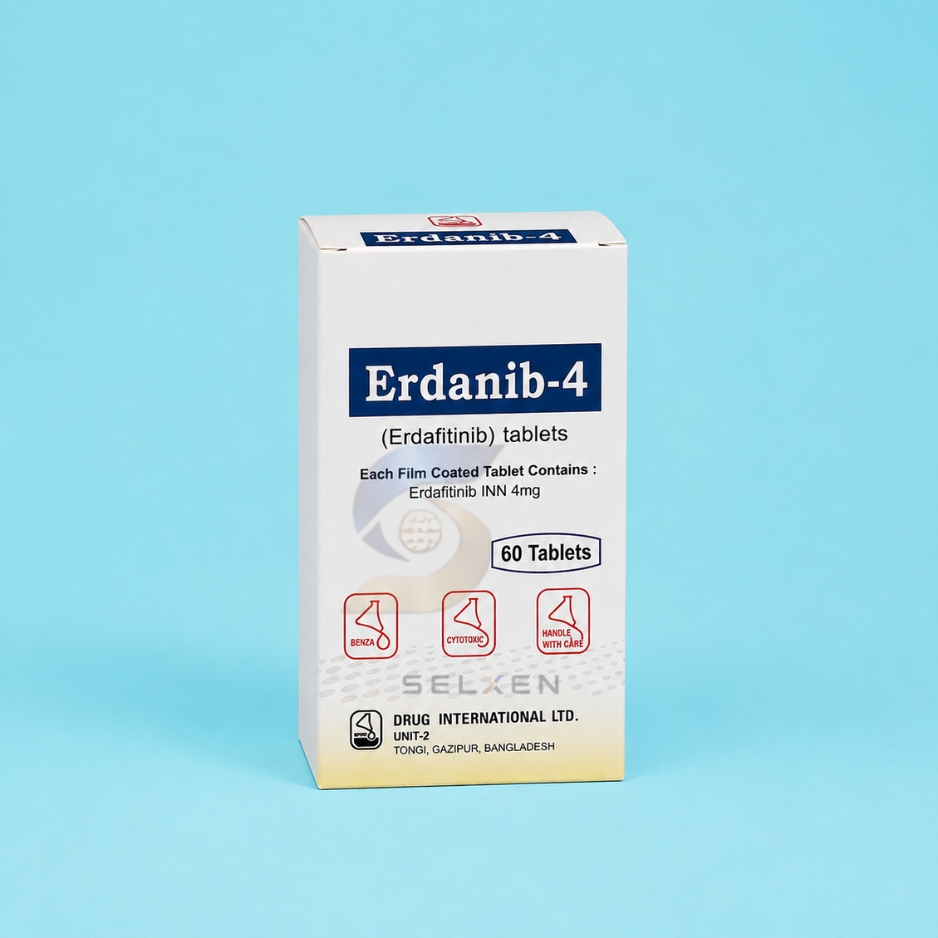
Erdanib 4 mg (Erdafitinib)
- Disclaimer : Before purchasing any medicine, always verify whether there is a valid drug license.
How to Know the Original Drug Products?
Check the packaging for clear printing, correct spelling, and the official logo. Verify batch numbers, manufacturing dates, expiry dates, and prices on the box and blister. Ensure seals and foils are properly intact. Finally, confirm the brand name, strength, and dosage form through reliable official medicine records before use.
Erdanib 4 mg contains erdafitinib, an oral targeted cancer medicine. It belongs to a group of medicines called fibroblast growth factor receptor (FGFR) inhibitors. Erdafitinib is used for selected adults with locally advanced or metastatic urothelial carcinoma. Treatment selection depends on finding a susceptible FGFR3 genetic alteration in the tumor. Current FDA prescribing information requires confirmation of the relevant FGFR3 alteration before treatment begins.
The 4 mg strength is a tablet strength. It does not mean every patient should take 4 mg daily. The labeled starting regimen for erdafitinib is 8 mg once daily, using two 4 mg tablets, with possible adjustment to 9 mg when treatment criteria are met. Erdanib 4 mg is a prescription medicine and should be used under specialist oncology supervision. Treatment requires monitoring because erdafitinib can affect phosphate levels, eyes, skin, nails, mouth, and other body systems.
Product Overview
| Product information | Details |
|---|---|
| Product name | Erdanib 4 mg |
| Generic name | Erdafitinib |
| Brand name | Erdanib |
| Strength | 4 mg |
| Dosage form | Oral tablet |
| Drug class | FGFR inhibitor |
| Therapeutic category | Targeted anticancer therapy |
| Manufacturer | Drug International Limited |
| Product type | Prescription medicine |
| Global access | Selxen |
The manufacturer information above follows the product information supplied for this page.
What is Erdanib 4 mg?
Erdanib 4 mg is an oral formulation containing erdafitinib. Erdafitinib is a kinase inhibitor that acts on FGFR1, FGFR2, FGFR3, and FGFR4. Its clinical use is more specific than its laboratory activity. The current FDA-approved indication concerns adults with locally advanced or metastatic urothelial carcinoma containing susceptible FGFR3 alterations. Therefore, Erdanib should not be presented as a general treatment for every FGFR-related cancer.
Selxen: Bridging Global Access and Knowledge
Selxen can position Erdanib 4 mg as both a pharmaceutical-access product and an information resource. The product page should make the purchasing process clear without replacing medical advice. Users should be able to understand the product, prescription requirements, sourcing process, availability, and documentation needed before ordering. For international customers, availability and delivery should be confirmed before payment. Delivery timelines should only be stated when they are supported by the actual fulfillment process.
Oncology Information Provider Section: Empowering Informed Choices
Cancer treatment decisions involve more than selecting a medicine. Patients should understand why the medicine was prescribed, what testing supports its use, which monitoring is required, and which symptoms need prompt medical attention. A useful Erdanib product page should therefore combine product information with safety education. It should also encourage patients to discuss treatment decisions with their oncologist.
Global Accessibility Through Selxen
Selxen provides a global access and knowledge bridge for customers seeking information about prescription medicines.
For Erdanib 4 mg, the key access questions include:
- Is the product currently available?
- What quantity is available?
- What prescription documentation is required?
- Where can the medicine be shipped?
- How is the product packaged?
- How can product details be verified?
- What information is needed before an order is confirmed?
Availability, pricing, shipping times, and payment options should be confirmed before publication or checkout.
Manufactured Excellence by Drug International Limited
Erdanib 4 mg is supplied in the product brief as being manufactured by Drug International Limited. The product page should display the manufacturer clearly because manufacturer information helps customers distinguish the medicine from unrelated products containing the same active ingredient. For E-E-A-T, avoid unsupported statements about manufacturing certifications or regulatory approvals. Any certification displayed on the website should be supported by current documentation.
Clinical Evidence
Clinical evidence for erdafitinib supports its use in appropriately selected patients with advanced urothelial carcinoma and susceptible FGFR3 alterations. In the randomized BLC3001 Cohort 1 study, 266 patients were randomized to erdafitinib or chemotherapy. Patients had advanced urothelial cancer with selected FGFR3 alterations and had previously received one or two systemic treatments, including at least one PD-1 or PD-L1 inhibitor.
Median overall survival was 12.1 months with erdafitinib compared with 7.8 months with chemotherapy. Median progression-free survival was 5.6 months compared with 2.7 months. The objective response rate was 35.3% with erdafitinib versus 8.5% with chemotherapy. These results describe a clinical-trial population. They do not guarantee an individual patient’s response. The FDA’s 2024 approval announcement also reported statistically significant improvements in overall survival, progression-free survival, and objective response rate in the relevant study population.
How Does Erdanib 4 mg Work?
Erdafitinib binds to and inhibits the enzymatic activity of FGFR1, FGFR2, FGFR3, and FGFR4. FGFR signaling can contribute to cancer-cell growth when specific genetic alterations are present. By inhibiting FGFR signaling, erdafitinib can reduce signaling associated with tumor-cell viability and proliferation. The current prescribing information confirms its activity against FGFR1–4 based on laboratory data. However, the clinical indication should not be expanded simply because the drug interacts with several FGFR proteins.
What Diseases Does Erdanib Treat?
The current FDA-approved use is for adults with locally advanced or metastatic urothelial carcinoma with susceptible FGFR3 genetic alterations, when the disease has progressed on or after at least one line of prior systemic therapy. Urothelial carcinoma most commonly affects the bladder, but it can also arise elsewhere in the urinary tract. Erdafitinib is not appropriate for every patient with urothelial carcinoma. Molecular testing is an important part of patient selection. The current U.S. label also states that erdafitinib is not recommended for patients who are eligible for and have not received prior PD-1 or PD-L1 inhibitor therapy.
Benefits of Erdanib 4 mg
Potential clinical advantages include:
- Oral administration.
- Targeted inhibition of FGFR signaling.
- Use in a biomarker-selected patient population.
- A treatment option for certain advanced urothelial cancers.
- Flexible tablet strengths that support physician-directed dose adjustment.
- Evidence of improved outcomes compared with chemotherapy in the relevant randomized study population.
These benefits do not mean erdafitinib is suitable for every cancer patient.
Who Can Take Erdanib 4 mg?
Erdafitinib may be considered for adults who meet the clinical criteria for treatment.
Selection depends on factors such as:
- Cancer type.
- Disease stage.
- Previous systemic therapy.
- FGFR3 genetic findings.
- Prior PD-1 or PD-L1 treatment.
- General health.
- Organ function.
- Current medicines.
- Potential treatment risks.
An oncologist should determine whether erdafitinib is appropriate.
Who Should Not Use It?
The current FDA label lists no formal contraindications for erdafitinib. However, that does not mean the medicine is suitable for everyone.
A physician should carefully assess patients with:
- Significant eye problems.
- Severe or uncontrolled phosphate abnormalities.
- Serious treatment-related adverse effects.
- Pregnancy.
- Potential drug interactions.
- Severe renal or hepatic impairment.
- A CYP2C9 poor-metabolizer genotype or suspected CYP2C9*3/*3 genotype.
Safety and effectiveness have not been established in pediatric patients.
Dosage of Erdanib 4 mg
The current FDA-labeled starting dose is 8 mg once daily. That equals:
Two 4 mg tablets once daily. After 14–21 days, the dose may be increased to 9 mg once daily when the required criteria are met, including tolerability and phosphate assessment. The dose should never be changed independently. Dose interruptions and reductions may be required for adverse reactions.
How to Take Erdanib 4 mg
Take erdafitinib exactly as prescribed.
- Swallow the tablets whole.
- Take them once daily.
- They may be taken with or without food.
- Do not crush or chew the tablets unless your healthcare professional specifically instructs you otherwise.
- Take the medicine at approximately the same time each day.
- Do not change the dose without speaking with your oncology team.
The FDA label confirms that food does not require a special dosing adjustment.
What Happens If You Miss a Dose?
If a dose is missed, take it as soon as possible on the same day. Resume the normal schedule the following day. Do not take extra tablets to compensate for a missed dose. If vomiting occurs after taking the medicine, the next dose should be taken on the following day rather than taking an additional dose.
Available Strengths
Erdafitinib tablets are available in:
- 3 mg
- 4 mg
- 5 mg
The available strengths allow oncologists to adjust the total daily dose when necessary.
Available Pack Sizes
The specific Erdanib 4 mg pack size should be confirmed with Selxen before ordering. For reference, the U.S. erdafitinib reference product is supplied in 4 mg bottles containing 28 or 56 tablets. This does not establish the pack size of Erdanib manufactured by Drug International Limited. Therefore, the Erdanib product page should display the actual pack size supplied by the manufacturer.
Side Effects and Safety Protocols
Erdafitinib can cause adverse reactions. Common adverse reactions and laboratory abnormalities include:
- Increased phosphate.
- Nail disorders.
- Stomatitis.
- Diarrhea.
- Increased creatinine.
- Fatigue.
- Dry mouth.
- Dry skin.
- Decreased appetite.
- Taste changes.
- Constipation.
- Dry eye.
- Palmar-plantar erythrodysesthesia.
- Hair loss.
- Central serous retinopathy.
Not every patient will experience these effects.
Blood-Related Side Effects
Laboratory abnormalities can occur during treatment. These may include changes in:
- Hemoglobin.
- Sodium.
- Creatinine.
- Liver enzymes.
- Phosphate.
- Calcium.
- Potassium.
Blood tests help the oncology team identify changes before they become clinically significant.
Serious Side Effects
Two safety areas deserve particular attention. Eye problems: Erdafitinib can cause central serous retinopathy or retinal pigment epithelial detachment. Visual symptoms should be reported promptly. The current label recommends monthly ophthalmological examinations during the first four months, then every three months. High phosphate: Erdafitinib can cause hyperphosphatemia and, in serious cases, soft-tissue mineralization. Serum phosphate should be monitored throughout treatment. Other serious reactions may require treatment interruption, dose reduction, or discontinuation.
Drug Interactions
Erdafitinib is primarily metabolized through CYP2C9 and CYP3A4. Therefore, some medicines can change erdafitinib exposure.
Important interaction categories include:
- Moderate CYP2C9 inhibitors.
- Strong CYP3A4 inhibitors.
- Strong CYP3A4 inducers.
- Moderate CYP3A4 inducers.
- Medicines that alter serum phosphate.
- Certain P-glycoprotein substrates.
Strong CYP3A4 inducers should be avoided with erdafitinib. Moderate CYP2C9 or strong CYP3A4 inhibitors may require an alternative medicine or close monitoring. Patients should provide a complete list of prescription medicines, OTC products, vitamins, and herbal supplements.
Foods to Avoid While Taking Erdanib
There is no general requirement to take erdafitinib on an empty stomach. The medicine can be taken with or without food. However, phosphate intake can become clinically relevant because erdafitinib can raise serum phosphate. The current label recommends restricting dietary phosphate to 600–800 mg daily and monitoring phosphate during treatment. Patients should follow the dietary plan provided by their oncology team rather than making major dietary changes independently.
Pregnancy and Breastfeeding
Erdafitinib can cause fetal harm. Women who can become pregnant should use effective contraception during treatment and for one month after the final dose. Male patients with partners who can become pregnant should also use effective contraception during treatment and for one month after the last dose. Pregnancy status should be checked before starting treatment in females of reproductive potential. Breastfeeding is not recommended during treatment and for one month after the last dose.
Monitoring During Treatment
Monitoring is an essential part of safe erdafitinib treatment. Your healthcare team may monitor:
Serum phosphate
Phosphate should be assessed 14–21 days after starting treatment and monitored monthly thereafter.
Eyes
Ophthalmological examinations are recommended monthly during the first four months, then every three months. Urgent evaluation is appropriate if visual symptoms develop.
Laboratory tests
Blood tests may monitor kidney function, liver enzymes, electrolytes, blood counts, and other parameters.
Clinical symptoms
Tell your healthcare provider about mouth sores, diarrhea, skin problems, nail changes, fatigue, appetite changes, or visual symptoms.
Advantages of Erdanib 4 mg
The main advantages of the 4 mg tablet include:
- Oral administration.
- Targeted FGFR inhibition.
- Useful tablet strength for dose adjustment.
- Use in biomarker-selected urothelial carcinoma.
- Established clinical evidence in an appropriate patient population.
The value of treatment depends on correct patient selection and appropriate medical monitoring.
Limitations of Erdanib 4 mg
Erdafitinib is not a universal cancer medicine.
Important limitations include:
- It is intended for selected patients.
- FGFR3 testing is required for the current approved indication.
- Treatment requires oncology supervision.
- Significant adverse reactions can occur.
- Eye monitoring is required.
- Phosphate monitoring is required.
- Drug interactions can affect treatment.
- Pregnancy presents a fetal risk.
- Treatment response varies between patients.
These limitations should be clearly communicated rather than hidden behind promotional language.
Genetic Testing Before Starting Treatment
Genetic testing is one of the most important parts of erdafitinib treatment. The current FDA label requires confirmation of a susceptible FGFR3 genetic alteration in the tumor before treatment begins. Testing can identify specific mutations or gene fusions. The FDA-approved companion diagnostic framework includes testing of tumor tissue for relevant FGFR3 alterations. Patients should ask their oncologist whether their pathology report includes the appropriate molecular testing.
Clinical Studies Supporting Erdafitinib
The strongest current evidence comes from BLC3001 Cohort 1. In this randomized study, erdafitinib produced a median overall survival of 12.1 months compared with 7.8 months for chemotherapy. Median progression-free survival was 5.6 months compared with 2.7 months. The objective response rate was 35.3% compared with 8.5% for chemotherapy. These results support erdafitinib as a treatment option for appropriately selected patients. They should not be interpreted as a guarantee of survival, tumor shrinkage, or treatment response for an individual patient.
Storage Instructions
For erdafitinib reference labeling, tablets are stored at controlled room temperature. The current FDA label specifies 20°C to 25°C, with permitted excursions between 15°C and 30°C. For Erdanib 4 mg, customers should follow the storage instructions printed on the manufacturer’s packaging.
Keep the medicine:
- In its original packaging.
- Away from excessive heat and moisture.
- Away from children.
- According to the manufacturer’s labeled storage conditions.
Manufacturer Information
Drug International Limited. Manufacturer information should appear clearly on the product page, invoice, and product packaging. Customers should compare the product name, strength, batch details, expiry date, and packaging before use.
Why Buy Erdanib 4 mg Through Selxen?
A high-trust pharmaceutical ordering experience should focus on transparency.
Selxen’s product page should provide:
- Clear product identification.
- Manufacturer information.
- Strength and dosage form.
- Prescription requirements.
- Availability confirmation.
- Transparent quotation or pricing.
- Secure ordering information.
- Packaging information.
- Product verification guidance.
- Customer support.
- Shipping information.
- Clear policies for prescription medicines.
Do not purchase prescription oncology medicines from sources that cannot provide adequate product information or prescription handling.
Shipping and Delivery
International delivery depends on destination, stock availability, documentation, customs procedures, and courier conditions. Therefore, avoid publishing guaranteed delivery times unless they are operationally verified.
Before placing an order, customers should confirm:
- Product availability.
- Required prescription documentation.
- Destination eligibility.
- Shipping method.
- Estimated delivery window.
- Total cost.
- Any required import documentation.
Authenticity Guarantee
Authenticity should be supported by a transparent process rather than a marketing statement alone.
Customers should be able to verify:
- Manufacturer name.
- Product name.
- Strength.
- Batch number.
- Expiry date.
- Packaging integrity.
- Label consistency.
Where available, manufacturer verification systems should be used. Selxen should publish only an “authenticity guarantee” if it has a documented sourcing and verification procedure supporting that claim.
Prescription Requirements
Erdanib 4 mg is a prescription anticancer medicine. It should only be used after evaluation by a qualified healthcare professional. A valid prescription or prescription verification process should be required according to the applicable dispensing rules. The medicine should not be purchased for self-treatment or used simply because a patient has bladder cancer.
Strong Patient-Safety Reminder
Erdanib 4 mg is a specialized cancer treatment. Do not start, stop, increase, decrease, or combine this medicine without medical guidance. Contact your healthcare provider promptly for new vision changes, severe skin or nail problems, significant mouth sores, persistent diarrhea, severe weakness, or other concerning symptoms.
Conclusion
Erdanib 4 mg (Erdafitinib) is an oral FGFR inhibitor manufactured by Drug International Limited according to the product information supplied for this page. The current FDA-approved use of erdafitinib is for selected adults with locally advanced or metastatic urothelial carcinoma involving susceptible FGFR3 genetic alterations. Patient selection requires appropriate molecular testing. The 4 mg tablet is a strength used within physician-directed dosing. The labeled starting regimen is 8 mg once daily, with possible adjustment to 9 mg after appropriate assessment.
Treatment requires careful monitoring of serum phosphate and eye health. Patients should also discuss other medicines, pregnancy plans, breastfeeding, and existing health conditions with their oncology team. For customers seeking Erdanib 4 mg through Selxen, the safest approach is to confirm product availability, prescription requirements, manufacturer details, packaging, and delivery arrangements before ordering.
FAQs for Erdanib 4 mg (Erdafitinib)
Why does phosphate need to be monitored during treatment?
Erdafitinib can increase phosphate levels in the blood. High phosphate may contribute to soft-tissue mineralization, so your healthcare team may regularly monitor serum phosphate.
Can Erdanib 4 mg be taken with food?
Yes. Erdafitinib can generally be taken with or without food. Take it consistently according to your prescribed schedule.
What should I do if I miss a dose of Erdanib?
Take the missed dose as soon as possible on the same day. Continue your regular schedule the next day. Do not take extra tablets to make up for the missed dose.
Can Erdanib 4 mg be used during pregnancy?
Erdafitinib can cause fetal harm. People who can become pregnant should use effective contraception during treatment and for one month after the final dose. Discuss pregnancy plans with your oncologist before treatment.
Can I breastfeed while taking Erdanib 4 mg?
Breastfeeding is not recommended during erdafitinib treatment and for one month after the final dose. Discuss alternative feeding options with your healthcare professional.
Does Erdanib 4 mg interact with other medicines?
Yes. Erdafitinib can interact with certain medicines, including some CYP2C9 and CYP3A4 inhibitors or inducers. Tell your doctor about all prescription medicines, OTC products, vitamins, and supplements you take.
Be the first to review “Erdanib 4 mg (Erdafitinib)” Cancel reply
Related products



Need Help?
Our friendly support team is here to assist you with orders, shipping, returns, product information, and any questions you may have. Contact us anytime, and we’ll be happy to help.
- 89 Motijheel, Dhaka, Bangladesh
Services
Copyright 2026. selxen.com All Rights Reserved
Product was successfully added to your cart!
Reviews
There are no reviews yet.